
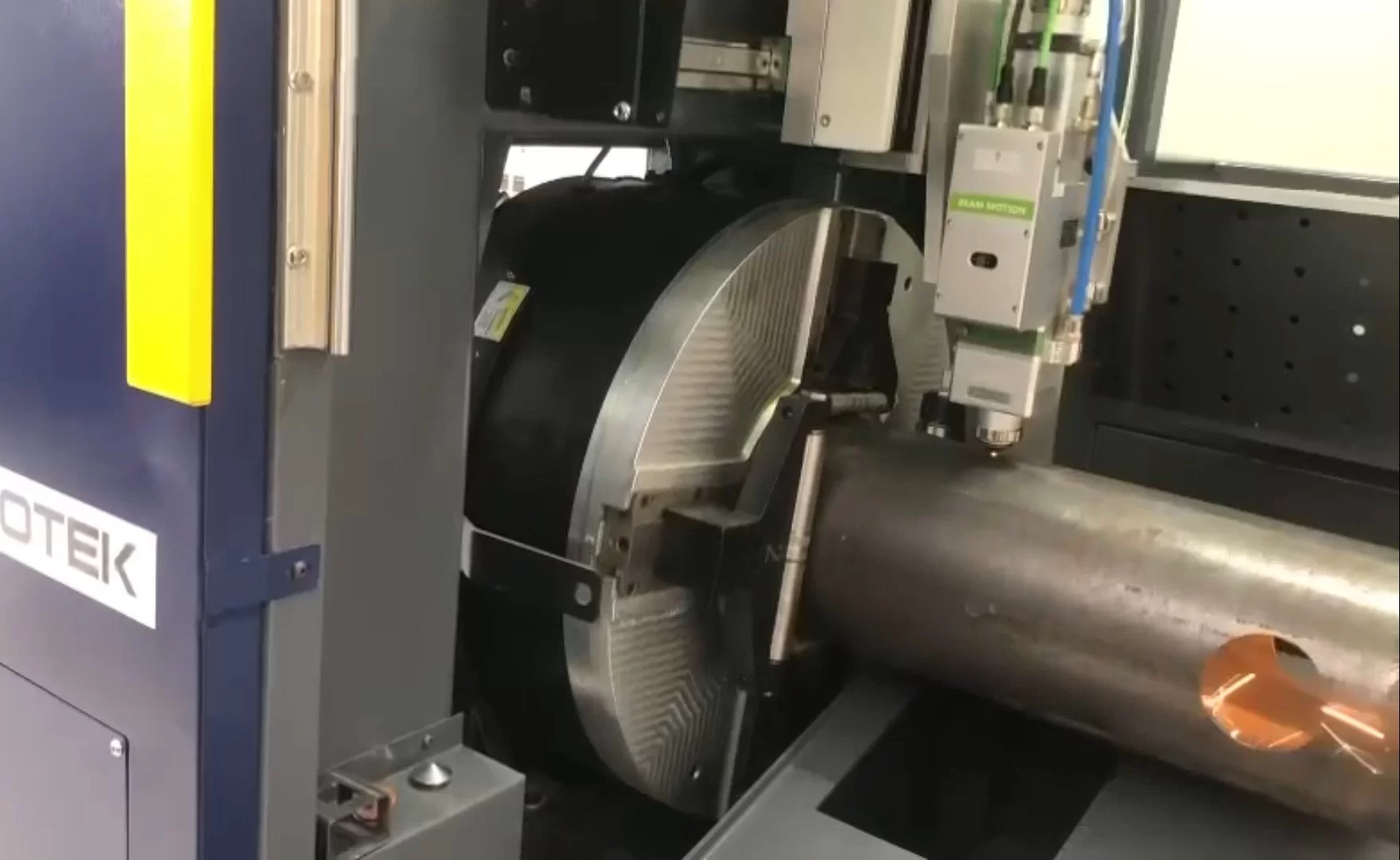
The 3D tube profile fiber laser cutting machine represents a revolutionary advancement in modern manufacturing technology. Tube profile fiber laser cutting utilizes a laser beam to cut materials in tube and profile shapes. This method ensures high precision and flexibility in cutting metal tubes and profiles. By enabling the cutting of tube and profile materials in a three-dimensional plane, this machine offers high precision, speed, and flexibility in industrial applications. With the integration of 3D tube profile fiber laser cutting technology, we are now capable of cutting carbon steel, stainless steel, aluminum, and brass materials with thicknesses ranging from 0.25 mm to 16 mm. Here is more detailed information about this technology as we continue to conduct our operations with this awareness.
Fundamentals of the Technology
Laser Cutting Principle: The laser cutting process is carried out by directing a focused laser beam onto the material. This focused beam provides enough energy density to cut the material. 3D cutting involves the laser beam moving in a three-dimensional space to cut tube and profile materials.
Fiber Laser Technology: Fiber lasers use optical fibers to generate the laser beam. This technology offers higher efficiency, lower maintenance requirements, and a longer lifespan compared to CO2 lasers. Fiber lasers are particularly ideal for metal cutting.
Applications
3D tube profile fiber laser cutting machines are widely used in many industries and applications:
-
Automotive Industry:
- Used for cutting chassis components, exhaust systems, and other tube and profile-based parts.
- Provides high precision and fast cutting times, which are advantageous for mass production.
-
Construction and Building:
- Used in the production of steel structural elements, support structures, and tube-based architectural features.
- Facilitates easy post-cutting assembly and enhances structural integrity.
-
Furniture and Interior Decoration:
- Used for cutting metal furniture frames, decorative tube profiles, and custom design elements.
- Offers design flexibility and aesthetic solutions.
-
Oil and Gas Industry:
- Provides high precision and reliability in cutting pipelines, flanges, and connecting parts.
- Effectively cuts hard and durable materials.
-
Aerospace:
- Used for cutting lightweight and durable materials.
- Ensures high precision in the production of aircraft and spacecraft parts.
Advantages
High Cutting Precision: 3D fiber laser cutting machines perform extremely precise cutting operations. This is especially important for complex and customized designs. Clean and smooth cutting lines reduce material waste and facilitate easy assembly.
Speed and Efficiency: These machines can cut at high speeds, accelerating the production process. This results in time and cost savings in mass production processes. Fast cutting enhances efficiency on production lines.
Flexibility: 3D tube profile fiber laser cutting machines can cut various materials and thicknesses. They can process different metals such as steel, stainless steel, aluminum, copper, and brass. Additionally, they are suitable for cutting tubes and profiles of various diameters and sections.
Reduced Waste: The high precision of the cutting process optimizes material use and reduces waste. This provides cost savings and minimizes environmental impact.
Low Maintenance Requirements: Fiber lasers are known for their low maintenance needs and long-lasting operation. This reduces operating costs and ensures uninterrupted production. Optical fibers maintain the quality of the laser beam for extended periods.
Cutting Process
-
Design and Preparation:
- The necessary design for the cutting process is prepared using CAD software. This design is digitally transferred to the cutting machine.
- The tube or profile material is placed and secured on the cutting table.
-
Cutting Process:
- The laser cutting machine directs the laser beam onto the material according to the design.
- The laser beam melts or vaporizes the material at the focused point, completing the cutting process. 3D cutting is achieved by directing the laser beam onto the material from various angles.
-
Final Inspection and Processing:
- After the cutting process is complete, the parts are removed from the cutting table.
- The cut parts undergo quality control processes and additional processing if necessary. This ensures that the parts are ready for assembly.
Cutting Parameters
Laser Power: Laser power affects the cutting speed and the quality of the material. High power enables faster cutting of thick materials, while lower power is preferred for thin materials.
Cutting Speed: Cutting speed is adjusted according to the type and thickness of the material. Fast cutting is suitable for thin materials, while a slower speed is preferred for thick materials.
Gas Type: The gas used during the cutting process affects the cutting quality. Oxygen is commonly used for cutting steel, while nitrogen is preferred for cutting stainless steel and aluminum. The gas cools the material during cutting and ensures a clean cut.
Focus Position: The focus point of the laser beam is adjusted according to the surface of the material. Correct focusing enhances the cutting quality and ensures smooth edges. Automatic focusing systems make this process faster and more precise.
Safety Measures
Safety measures are crucial during 3D fiber laser cutting operations. Here are some essential safety measures:
Protective Eyewear: Laser beams can damage the eyes, so operators should wear protective eyewear to prevent direct exposure to laser beams.
Ventilation: Smoke and gases generated during the cutting process should be exhausted using proper ventilation systems to maintain a clean and safe working environment.
Machine Protection: Laser cutting machines should be equipped with safety covers and sensors to protect users. This prevents accidental exposure to the laser beam.
Economic and Environmental Benefits
Cost Savings: 3D fiber laser cutting provides cost savings to businesses through high efficiency and low maintenance costs. It also reduces material waste, lowering raw material costs.
Energy Efficiency: Fiber lasers consume less energy compared to traditional laser cutting technologies. This reduces energy costs and minimizes environmental impact.
Environmental Impact: The laser cutting process is environmentally friendly due to low waste production and energy efficiency. Additionally, minimal chemical use during laser cutting reduces environmental pollution.
Future Developments
3D fiber laser cutting technology is continuously evolving. In the future, more powerful lasers, more precise cutting technologies, and advanced automation systems will further enhance this technology. Additionally, it is expected that technologies capable of cutting new materials will be developed.
Automation and Robotics: Automated loading and unloading systems can make production processes faster and more efficient. Robotic arms can perform cutting operations more precisely and quickly.
Artificial Intelligence and Machine Learning: AI and machine learning can be used to optimize cutting parameters, enhancing cutting quality and making material use more efficient.
Conclusion
3D tube profile fiber laser cutting machines are emerging as a revolutionary technology in the metalworking industry. Their advantages, such as high precision, speed, and flexibility, make them widely used across various industries. This technology enhances efficiency in modern production processes and allows for quicker and more effective responses to customer demands.
With the continuous advancement of technology, the use of 3D tube profile fiber laser cutting machines is expected to become more widespread and expand into different application areas. This marks a significant development in driving innovation and quality in the metalworking industry. In the future, it is anticipated that these machines, along with new technological developments, will find broader applications in industrial production.